Why Hybrid Quantum Computing Needs a Semantic Layer
Quantum computers are not just quantum.
Every real quantum system today is fundamentally hybrid: fragile quantum hardware wrapped in thick layers of classical software that schedule jobs, manage uncertainty, coordinate measurements, validate constraints, and interpret results. As quantum hardware evolves, this classical reasoning burden is only growing.
Yet most quantum programming frameworks focus almost entirely on circuit descriptions tied closely to physical execution, leaving critical reasoning tasks—uncertainty management, deferred commitment, measurement ordering, and policy enforcement—embedded implicitly in ad hoc host-language code.
This paper introduces a different approach: a symbolic semantic layer for hybrid quantum systems that captures the logical structure of quantum computation without modeling quantum physics itself .
The Core Claim (and the Non-Claim)
The paper makes a very precise claim:
We can model the semantics of quantum computation—uncertainty, correlation, phase, and irreversible commitment—using purely classical symbolic constructs.
Just as important is what the paper explicitly does not claim:
- No simulation of amplitudes or wavefunctions
- No modeling of noise or physical error
- No computational speedup
- No “quantum advantage” rhetoric
This is not a physics paper. It is a programming-model and systems paper.
The Problem: Hidden Semantics in Hybrid Workflows
In current hybrid quantum systems:
- Uncertainty is often implicit or probabilistic
- Measurement boundaries are scattered across classical control code
- Correlation between outcomes is handled informally
- Commitment timing is difficult to audit or verify
As a result, programmer intent is obscured, verification is brittle, and policy enforcement (resource limits, trust boundaries, measurement rules) becomes an afterthought rather than a first-class concern .
The paper argues that this is not a hardware problem—it’s a semantic gap.
TSPF: A Symbolic Vocabulary for Hybrid Quantum Reasoning
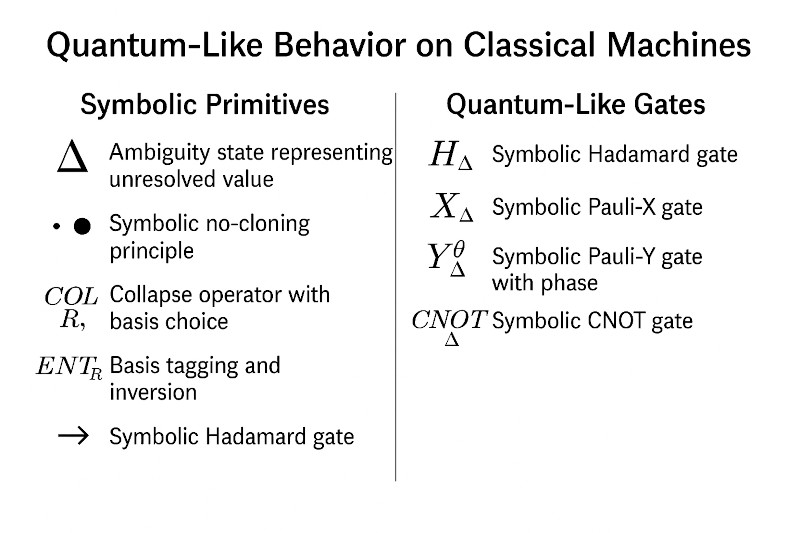
The Triangle Symbolic Processing Framework (TSPF) fills that gap by introducing a small, explicit symbolic vocabulary:
- Δ (Ambiguity)
A first-class state representing unresolved alternatives. Ambiguity can persist, branch, or be constrained—without being prematurely collapsed. - COLΔ (Collapse)
An irreversible semantic operation that resolves ambiguity and establishes a clear commitment boundary. - ENT (Symbolic Correlation)
A declarative way to express that outcomes are related, without assuming physical entanglement or nonlocal effects. - 𝜃 (Symbolic Phase)
A lightweight parameter representing coherence, alignment, or consistency across symbolic registers.
These constructs are semantic, not physical. They exist to make reasoning about hybrid execution explicit and inspectable .
Why Triangles?
The use of triangles is not geometric mysticism.
Triangles serve as a minimal rigid identity scaffold for symbolic registers—stable under:
- ambiguity,
- branching,
- correlation graphs,
- and irreversible collapse.
In hybrid workflows with deferred commitment, identity stability matters. Naive variable naming or SSA-style representations become fragile when ambiguity persists across multiple execution paths. The triangle provides a compact, compositional way to preserve identity without over-interpreting its shape or geometry .
Collapse as a Semantic Boundary
One of the paper’s most important contributions is its treatment of measurement as an explicit semantic boundary.
Before collapse:
- Reasoning occurs over unresolved alternatives
- Multiple symbolic paths may coexist
After collapse:
- A definite symbolic value is committed
- Prior ambiguity is no longer accessible
This mirrors the logical role of measurement in quantum computation, while remaining entirely classical in representation and implementation. The irreversibility is semantic, not physical—and that distinction is intentional .
Compilation as Semantic Realization
TSPF is not a compiler in the traditional sense.
Instead of lowering code instruction-by-instruction, it performs semantic realization:
- Validate symbolic programs against backend capabilities and constraints
- Map symbolic constructs to backend-supported mechanisms
- Re-assimilate execution outcomes into the symbolic state model
This allows:
- backend-agnostic coordination,
- early detection of infeasible workflows,
- explicit policy and trust enforcement,
- and adaptive execution across multiple runs .
What This Enables
By making uncertainty, correlation, and commitment explicit, TSPF enables:
- auditable hybrid workflows,
- constraint-aware execution planning,
- principled control over measurement and collapse,
- safer adaptive and iterative quantum-classical programs.
Crucially, it does so without depending on the details of quantum hardware, making it resilient as backends evolve.
Why This Matters Now
As quantum systems scale, the limiting factor is not just qubits—it is how well we reason about them.
This paper argues that we need a semantic layer that:
- sits above circuits and below orchestration,
- structures reasoning rather than simulating physics,
- and treats uncertainty and commitment as first-class concepts.
TSPF is one such layer. It does not replace existing tools—it makes them safer, clearer, and more auditable.
Final Thought
Quantum computing does not fail because we lack abstractions.
It fails when abstractions hide the very semantics we need to reason about.
This work is an argument for clarity over mystique, semantics over simulation, and disciplined reasoning over ad hoc control logic.